

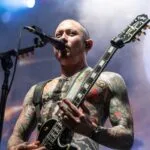





Ryan Shuck, a former bandmate of Chester Bennington in Dead by Sunrise, recently opened up about his battle with alcoholism and suicidal thoughts following the Linkin Park frontman’s death. He shared his story in an interview with FullCircleDC.

Shuck discussed how the combination of Chester’s death, the COVID-19 pandemic, and the release of Julien-K’s album “Harmonic Disruptor” pushed him to a breaking point.
“I’d gotten to a point with my with my drinking, especially when COVID hit, I would just start drinking in the morning,” Shuck said. “We’re scrambling to figure out what to. We started a Patreon, which was wildly successful, but we just needed to figure out what to do because all of a sudden, all of our money got turned off. Everyone I know went through it, and this is just what happened to me and Harmonic Disruptor was there. It was out, and it was this like lamentation, and it was like this album where we wanted to revisit our roots, and then Chester dies.”
The musician described the emotional toll of releasing an album during the pandemic while grieving his friend’s death.
“It was an absolute explosion and I think it’s one of the best albums we’ve ever done,” he continued. “But right when we put it out, we were shut down. And so I was just like, ‘Man, what am I going to do?’ So, I just decided the world’s closed, so I’m going to go ahead and I’m going to let go of everything. And I’m going to go see what it is like to not drink. And I was terrified. I was just shaking.”
Shuck revealed the depth of his struggles and his decision to seek help.
“And I checked myself into rehab for, you know, got me away from drinking,” he said. “It just turned out that, you know, Harmonic Disruptor just sort of broke me, you know. I just couldn’t deal with Chester’s death and I couldn’t get out of it. And I would drink to the point that I could, you know, that I could try to be in oblivion or die. I was very suicidal. And I was suicidal before Chester; I had attempted suicide before that. So, I was already, you know, going down the very, very dark path.”
He described his mindset at the time with stark honesty.
“And so I did the biggest thing I could do in my life, and I just said, ‘Hey, look, I’m going to go try and not drink, and if it sucks, then I can come back. I can buy the liquor store on the corner. I can drink all of it and I can light it on fire, and I can blow my brains out in the pool and it’ll look super cool.’ That’s how sick I was,” Shuck explained.
Five years into sobriety, Shuck reflected on his recovery and productivity.
“But I stopped drinking and here I am five years later and 10 times more productive than I was,” he said. “Is life easier? No. You know, I mean, it’s hard. Does it make Chester any easier to deal with? No. But, you know, it’s harder when you drink yourself into oblivion. You definitely are capable of some darker things. But we finally got to a point where we were able to make up that tour finally. We went out and played Harmonic Disruptor much later than we wanted to and it turned out to be a high-performing album.”
Shuck’s experience reflects the broader impact of Bennington’s death on the music community and the ongoing conversation about mental health in the industry. The Linkin Park frontman’s passing in 2017 sent shockwaves through the music world. It particularly affected those closest to him.
Louder Sound reported that Mike Shinoda, Linkin Park’s co-frontman, discussed the emotional turmoil he experienced following Bennington’s death. He acknowledged feeling anger as part of the grieving process. Shinoda also highlighted the complexity of Bennington’s personality, noting that while he was a “fun-loving dude,” he was also deeply troubled by his personal demons.
Bennington’s openness about his struggles with depression and addiction helped raise awareness and reduce stigma around mental health issues. Our Mental Health noted that his legacy continues to inspire discussions about mental well-being in the music industry. It encourages a culture of speaking openly about personal struggles and seeking help when needed.
The aftermath of Bennington’s death saw an outpouring of support from fellow musicians and fans. This emphasized the need for ongoing mental health support within the industry. Music Musings and Such highlighted that the tragedy fostered a sense of solidarity among musicians and fans. It emphasized the importance of support and open dialogue about mental health challenges.
The music community was also affected by the loss of Chris Cornell, who was a close friend of Bennington. The proximity of their deaths, both in 2017, highlighted the vulnerability of musicians to mental health crises. It underscored the urgent need for better mental health resources in the entertainment industry.


