


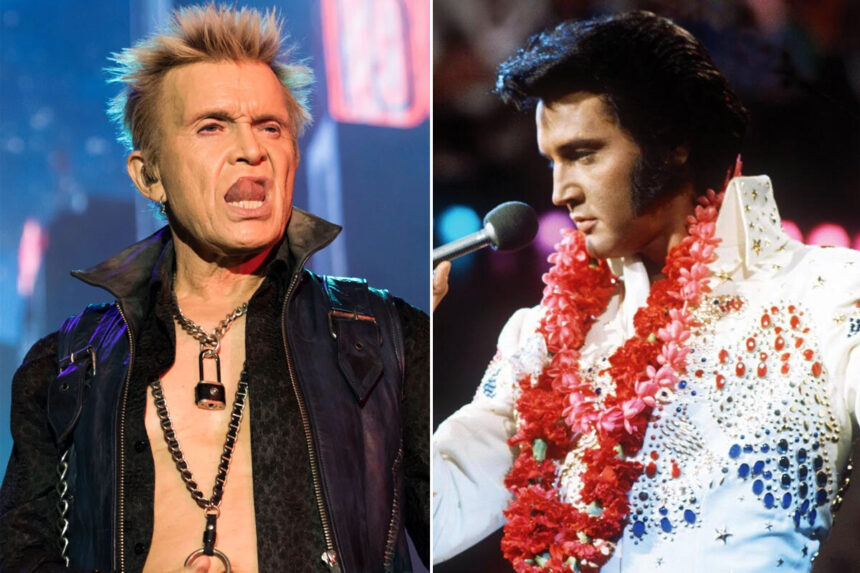
Steve Stevens has shared a wild story from his early days on the road with Billy Idol, revealing that Idol once spray-painted a message on the wall outside Graceland before taking a private tour of Elvis Presley’s famous home.

The legendary guitarist told the story during a recent interview with Rocking With Jam Man. While looking back on the Rebel Yell era, Stevens said life on tour with Idol could become strange, chaotic, and completely disconnected from normal reality.
That period was a major chapter in Idol and Stevens’ career. Rebel Yell was released in 1983, and Idol’s official site lists Stevens as a key collaborator on songs including “Rebel Yell,” “Eyes Without A Face,” and “Flesh for Fantasy.”
One of the most shocking stories Stevens remembered took place in Memphis, at Graceland. The estate is one of the most iconic places in rock history, and it remains closely tied to Elvis Presley’s legacy. Graceland’s official site describes the mansion tour as a way to explore the personal side of Elvis Presley, while Memphis Travel notes that the wall in front of the mansion is covered with messages from fans.
But according to Stevens, Billy Idol did not just leave a normal fan message.
Stevens explained:
“When we got to Graceland, you know, Billy really wanted to visit Graceland. Actually, we on that tour on Rebel Yell, we had Elvis Presley’s original bodyguard, Ed Parker. So, we got a tour of Graceland, a private tour, and the night before Billy went out to the wall, the cement wall of Graceland, got spray paint and put ‘Billy Idol Forever’ up on there. And we showed up the next day and we’re like, ‘Oh, gee, I wonder how that got there.’ You know, so there’s a lot of crazy, crazy [__] like that going on.”
The story shows just how fearless and reckless the Rebel Yell tour could be. Idol and Stevens were already rising fast, and the band was living through the kind of intense road schedule that often defined rock tours in the 1980s.
Stevens said those long tours could make the band lose touch with everyday life. After months on the road, the group would often do things just to get a reaction. He described a world of hotel chaos, strange behavior, and constant attempts to break the boredom of touring.
In that context, the Graceland incident becomes more than just a prank. It was a classic Billy Idol moment: rebellious, disrespectful to the rules, but also strangely connected to rock history. Idol was visiting the home of Elvis Presley, one of the biggest icons in music, and decided to mark the place with his own name.
The story also fits the image Idol built during the 1980s. His music mixed punk attitude, rock hooks, and MTV-era style, while Stevens’ guitar playing gave songs like “Rebel Yell” their sharp and dramatic edge. Guitar Player reported that Stevens and Idol recorded Rebel Yell with producer Keith Forsey in 1983, calling the album the basis of Stevens’ long career with Idol.
Over the years, Idol has been open about how chaotic his life became during that era. In a 2024 interview, he even revealed that he once stole the master tapes for Rebel Yell during a fight with his record label over the album cover.
Because of that history, Stevens’ Graceland story does not feel out of character. It sounds like another example of the same wild energy that followed Idol during his rise.
Still, the detail that makes the story stand out is the timing. Idol and Stevens had access to a private Graceland tour, reportedly guided by Elvis Presley’s original bodyguard, Ed Parker. But instead of treating the visit with quiet respect, Idol had already left “Billy Idol Forever” on the wall the night before.
The next day, they simply acted innocent.
For Stevens, it was just one of many crazy moments from that time. For fans, it is another glimpse into the reckless spirit behind one of Idol’s most famous eras.
Decades later, the story feels like a perfect snapshot of 1980s rock excess: a young star, a legendary guitarist, a sacred rock landmark, and a can of spray paint.


