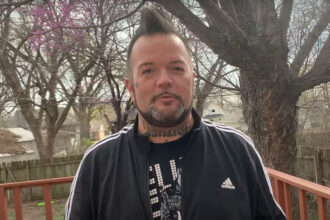






Helloween vocalist Michael Kiske recently opened up about the circumstances surrounding his departure from the band in the mid-1990s. He discussed the topic in an interview with Chris Jericho.

Kiske was asked directly about the period following the release of Chameleon in May 1993 and what led to his exit from the band roughly six to eight months later. He revealed that while the decision was not entirely his own, his behavior at the time played a significant role in the outcome.
“So, we’re talking now about how you left shortly after ‘Chameleon’ album comes out because Chameleon comes out, you know, May of 93 and you mentioned you’re gone in 94, 6, eight months later. What happened in that time frame for you to make that decision?” Jericho asked.
“I mean, they fired me. It was like I didn’t make that decision, but I was laying bombs,” Kiske said. “I mean, looking back at it now, subconsciously I knew that I had to do something else for a while.”
Kiske went on to describe how his actions during that period were, in hindsight, a form of self-sabotage driven by an underlying desire to move on.
“So, it’s like I was kind of feeding everything when they were complaining about something, I was doing as extra, you know, when I criticized something, I was intentionally doing it,” he continued. “You know, it’s like it was obviously I was laying bombs. That’s how I would describe it.”
He also reflected on how he felt when he received the news of his dismissal. His reaction, he noted, revealed more than he realized at the time.
“I remember when I had this call of our then manager saying they don’t want to continue with you. I was fine,” Kiske said. “You know, in the first moment I was disappointed, but the next day I was fine. And looking back at it, that shows me it was okay with me because I knew I had to do something else for a while. And it was all good. It was all good for me. I learned as a person. I grew as a person.”
Kiske concluded on a positive note, reflecting on his eventual return to Helloween — one of heavy metal’s most celebrated reunions.
“And now we can do all this together again, which I never expected for many years, you know,” he said. “I ever always denied anything like this, but there you go.”
Kiske’s comments offer a candid look at one of the most discussed chapters in Helloween’s history. They shed new light on the events surrounding Chameleon and his long road back to the band.
To fully understand the weight of Kiske’s admission, it helps to look at the broader context of what Chameleon represented for Helloween and what its failure ultimately cost the band.
Chameleon marked a dramatic stylistic departure for Helloween. The album steered the band away from the power metal sound that had defined their identity and into far more experimental territory. The shift alienated a large portion of their fanbase and proved to be a commercial failure. Its predecessor, Pink Bubbles Go Ape, had already struggled commercially. Together, the two albums created a period of deep instability within the group.
The internal tensions that had been building throughout the Chameleon cycle were not limited to Kiske. During the album’s supporting tour, drummer Ingo Schwichtenberg was also removed from the band due to personal struggles. A replacement stepped in to finish the remaining shows. By the end of 1993, the situation within Helloween had reached a breaking point, and Kiske’s dismissal followed shortly after.
His last performance with Helloween during that original run took place at a charity show in Ludwigsburg on December 22, 1993. That date marked the end of an era for the band and the beginning of a long, complicated chapter for Kiske personally.
What followed was more than two decades apart. Kiske pursued a solo career and various collaborative projects before the idea of a reunion with Helloween became a reality. When he finally returned to the stage with the band, it had been 24 years since that final December show. The gap made the reunion all the more remarkable for fans who had long considered it an impossibility.
The reunion brought together multiple classic-era members of Helloween. It was widely celebrated as one of the most significant events in heavy metal history. For Kiske, it represented not just a return to the band, but a full-circle moment that he himself had once dismissed as something that would never happen.