




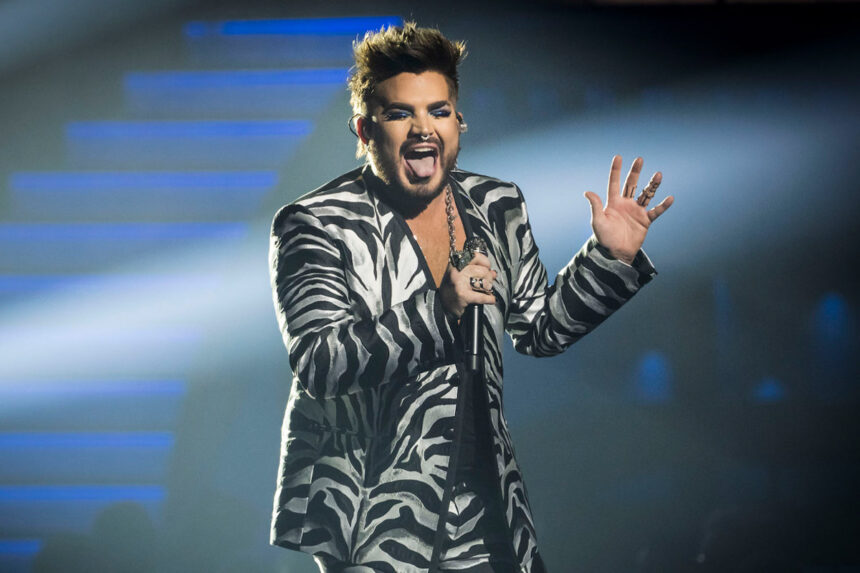
Adam Lambert recently spoke out about the impact of toxic masculinity on gay men. He shared his thoughts in an interview on Josh Smith’s Great Chat Show.
The Queen frontman addressed how societal expectations around masculinity contribute to fear and shame within the gay community. He also explained why he believes gay men face a particular kind of scrutiny from the straight world.
“We’re already dealing with our own shame around who we are — especially gay men, I think,” Lambert said. “I think gay women have their own set of stuff that they deal with, too, but it’s a little less scrutinized by the straight world… But I think the reason why gay men get it worse than the gay women is because of toxic masculinity. It’s because society expects men to act a certain way, to look a certain way, and if you don’t, you’re not a man or you’re not enough of a man. And people are so afraid.”
Lambert also turned his attention to a trend he has noticed within the gay community itself — a pressure to conform to a particular look or lifestyle.
“I saw a picture the other day and I was, like, ‘Geez, they all look the same,'” he continued. “And they all look great. I’m, like, ‘Go on. Good job. You were working real hard in the gym. Get it.’ I get a little freaked out by that scene. I’m, like, ‘Does anybody wanna look different? Does anybody wanna express something that’s singular, that’s their own thing to help them stand apart from everybody?’ Like, why do you guys all look the same?”
He went on to reflect on what he sees as a broader reluctance among some gay men to stand out.
“And there is a thing, I think, within the queer community that I’ve noticed, where people don’t wanna stick out. They don’t wanna look weird,” Lambert said. “There is a mindset among certain gay men, like, ‘I just wanna be, quote-unquote, normal. I’m just like a straight guy except I happen to sleep with men.’ Okay. I’m not here to criticize that, but isn’t that kind of boring? I don’t know.”
Acknowledging his own perspective as an artist, Lambert offered some nuance before pressing the deeper question.
“Look, I’m a creative. It’s different for me. I’m a theater kid. I’m an artist. Of course I’m gonna be more outrageous,” he said. “And, of course, there are gay men that are sort of like… they live, quote-unquote, normal lives. They have a job that’s a more pedestrian job, maybe. Their interests are maybe less colorful and weird and wild than mine, and that’s fine. But how much of it is natural and just how they are, and how much of it is because they’re afraid to express that? How much of it is because they just wanna be accepted? It’s the chicken or the egg. What is it?”
Lambert concluded by pointing to both external and internal pressures as driving forces behind this tendency toward assimilation.
“I think some of it is for the acceptance from the straight world, but I also think a lot of it is within the community too, is that there’s such a shame around anything other than a masc man that all these guys are assimilating into that in order to be validated or in order to be desirable,” he said.
The comments reflect Lambert’s ongoing engagement with issues of identity and self-expression within the LGBTQ+ community. It is a subject he has addressed with increasing candor as his career has evolved and his platform has grown.
Lambert’s voice on these matters carries particular weight given his standing as one of the most prominent openly gay figures in mainstream rock music. He made history as the first openly LGBT vocalist to debut an album at number one. His years fronting Queen alongside Brian May and Roger Taylor have placed him at the center of one of the most iconic stages in rock. That position has given him both the visibility and the credibility to speak on issues that many in the industry still avoid.
His advocacy extends well beyond interviews. In 2020, Lambert founded the Feel Something Foundation, a non-profit organization dedicated to supporting LGBTQ+ human rights. The initiative reflects a long-standing commitment to the community that runs parallel to his artistic career. It also underscores the seriousness with which he approaches these conversations.
Lambert has also been candid about the broader progress he has witnessed since first entering the public eye. “It’s incredible how much change has happened,” he has said. “When I first came out into the music scene, there weren’t really any other gay men doing mainstream pop music.” That historical context makes his current observations about conformity and shame all the more pointed. He is speaking not just as a commentator, but as someone who lived through the era when visibility itself was the battle.
Now, with his sixth studio album set for release in July 2026, Lambert appears to be entering a new chapter defined by creative freedom and self-determination. It is his first release as a fully independent artist. He has described the project as a labor of love, one made possible by his own means. The timing feels deliberate: an artist who has spent years challenging what a gay man can look and sound like is now doing it entirely on his own terms.