




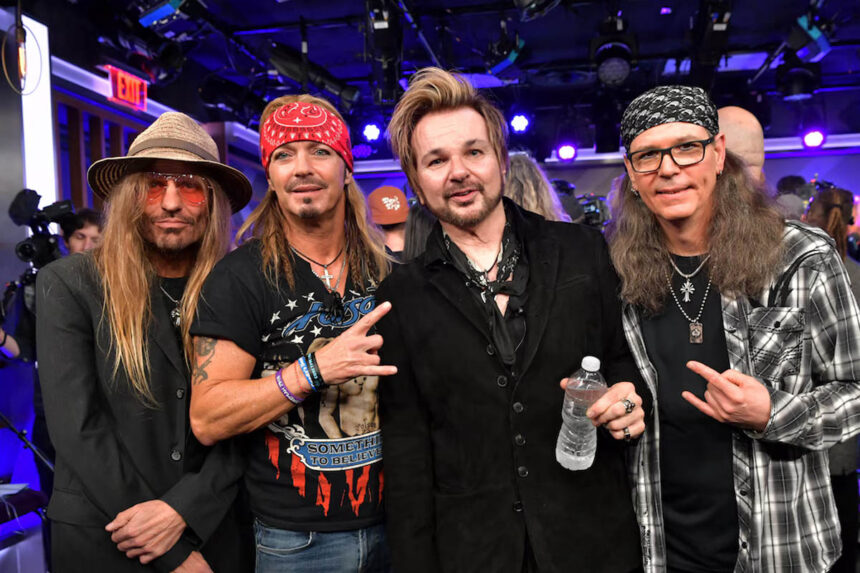
Poison drummer Rikki Rockett recently opened up about the circumstances surrounding C.C. DeVille’s firing from the band, sharing his own side of the story.

Rockett addressed the matter after being asked directly about how the guitarist reacted to the news of his dismissal from the band.
Responding to the question, “You know, C.C. DeVille, it’s no, it’s no surprise to anybody in Poison’s history. C.C. was fired from the band when you guys told him that he was fired. What was his reaction? I think that was missing from the book. Or did he already have two feet out the door, so to speak?” Rockett explained his own limited role in the decision.
“I didn’t fire him. I’m trying to remember who did. I don’t know if Bobby talked to him or Bret did. I don’t remember now,” Rockett said. “So, I don’t know what the reaction was, but I didn’t feel good about it for weeks and weeks and weeks.”
He went on to describe how uneasy the decision made him feel, given the band’s limited options at the time.
“Like, it just it never honestly it never sat right with me,” Rockett continued. “Because at that point in time, we really didn’t have the only thing we could have done is just put the band on the back burner, right, for a period of time. And that could have been years. I mean, honestly, you know, we didn’t know what we were going to do, but um we wanted to keep going. We had commitments and we knew it wasn’t going to happen with him at that point in time. You know what I mean?”
Rockett also praised DeVille’s songwriting talent, even while acknowledging his struggles at the time.
“But C.C. at his worst, okay, I mean, drug addicted, strung out for three days, can still write a hit song,” he said. “I mean, the man is still a musical prodigy in so many ways. And it’s not about how incredible he plays guitar or uh any of those kinds of things. It’s just his all around approach to a song. These are really good songs that we crafted. And he was a huge part of those songs. Always has been. And I knew it. And I think we all knew it, you know. But no, when we got Richie in the band, it was just a different head space.”
He concluded by reflecting on how the band adapted after the lineup change.
“We had to think about things differently and we saw that as a challenge and we took on that challenge and I think we did a great job with it,” Rockett said. “I think all of us, all four of us did a great job on that record.”
Rockett’s hesitation over naming who actually delivered the news lines up with just how chaotic and fractured the band’s dynamic had become by that point. The firing didn’t happen in isolation. It was the culmination of years of mounting tension that finally boiled over in dramatic fashion.
The breaking point came at the 1991 MTV Video Music Awards, where Poison was slated to perform “Unskinny Bop” from their latest record. Instead, DeVille launched into an entirely different song, “Talk Dirty to Me,” catching his bandmates off guard on live television.
The onstage disaster spilled over almost immediately backstage, where DeVille and Bret Michaels got into a physical altercation. That confrontation is widely regarded as the final straw that sealed DeVille’s fate with the band.
Poison moved forward by bringing in guitarist Richie Kotzen to fill DeVille’s spot, a change that ushered in the different “head space” Rockett referenced. The band’s approach shifted considerably under the new lineup, eventually leading to the release of “Native Tongue” in 1993.
DeVille’s playing and songwriting had deeply shaped Poison’s earlier hits. Replacing him meant more than just swapping out a guitarist. It meant reworking the band’s entire creative process from the ground up.


