



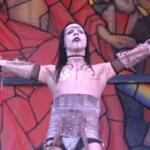



Maynard James Keenan, the frontman of Tool and Puscifer, recently shared his perspective on the evolution of punk and underground music scenes. He addressed concerns about whether grassroots movements like the original punk explosion could emerge in today’s environment. His comments were featured in an interview with NME.

The discussion centered around the challenges facing modern musicians in finding the raw, uncompromising spaces that once fostered punk culture. When asked whether big movements like the first explosion of goth and punk scenes could happen today, Keenan reflected on his own experiences.
“That’s a long conversation because, when I was growing up in bands, we were literally finding some warehouse on the outside of town that still had electricity plugged into it,” Keenan said. “There would be some alcoholic dude who, if you just slipped him 10 bucks, you could get in and staple some carpet that smelled like cat piss on the wall, and then that was your rehearsal space.”
He continued to describe the gritty reality of those early punk spaces. He emphasized their importance despite their less-than-ideal conditions.
“Chances are it smelled like cat piss, cigarettes, mildew and mould… but you could be as loud as you could,” he explained. “You could explore music in this space where no one was going to clip your wings. Now, though, you’ve really got to try and find that same space, and it doesn’t exist anymore.”
The 61-year-old musician acknowledged the impact of gentrification on these creative spaces. He maintained hope for future movements.
“I don’t think it has to go back to that, though. There are still ways that you can have that rough, punk, uncompromising mentality,” Keenan noted. “Keep in mind, I’m 61, so I’m going to think of punk-rock in the way that I remember it… in ways that you will never experience now because all those areas and all those buildings have been gentrified. They’re beautiful $10,000 a month loft apartments, or they’re selling $6 coffees now. It’s not the same thing. Those spaces just don’t exist, and if you’re going to get loud, you’re gonna get sued.”
Despite these challenges, Keenan expressed optimism about the future of underground music movements.
“I think that [new scenes] have to manifest in a way that has more to do with now, and I don’t know what that is because I’m the old dude,” he concluded. “But I do know it is happening, because it can’t not happen.”
Keenan’s reflections on the changing landscape of underground music carry particular weight given his extensive experience across multiple successful projects. His unique perspective as both musician and entrepreneur adds depth to his observations.
Wikipedia reported that Keenan is not only the frontman of Tool but also leads A Perfect Circle and Puscifer. This makes him one of rock’s most prolific multi-band artists. Born James Herbert Keenan on April 17, 1964, his journey to musical prominence began after relocating to Los Angeles in 1988. He initially worked in interior design and set construction before forming Tool in 1990.
The musician’s current life reflects his evolution beyond the gritty warehouse spaces he once inhabited. Phoenix New Times noted that Keenan has been an Arizona resident since 2005. He lives in the historic mining town of Jerome where he operates Caduceus Cellars winery and a Puscifer retail store. This transformation from underground musician to successful entrepreneur illustrates the very gentrification and commercialization he discusses in his recent comments.
Keenan’s multifaceted career extends far beyond music performance. Rayo documented that the legendary rock star has established himself as a winemaker, writer, artist, restaurateur, and business owner. He maintains his role as frontman for three distinct bands. This diverse portfolio demonstrates how modern artists must adapt and find new creative outlets in an increasingly commercialized landscape.
His perspective on the future of punk movements comes from someone who has successfully navigated the music industry’s evolution over more than three decades. Having witnessed firsthand the transformation from DIY warehouse spaces to today’s regulated, expensive creative environments, Keenan’s observations about the need for new forms of artistic rebellion carry the authority of lived experience across multiple generations of underground music culture.


