


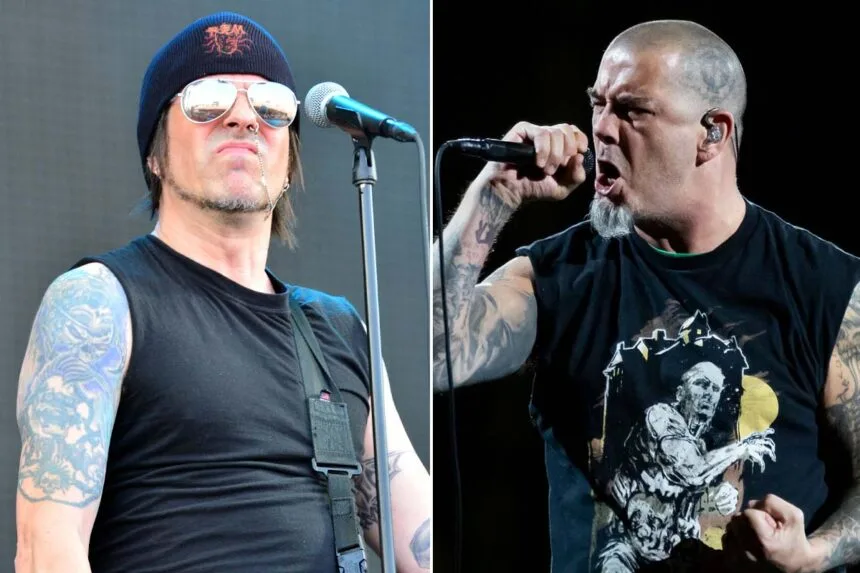
Skid Row bassist Rachel Bolan recently opened up about the band’s early touring days. He revealed a surprising behind-the-scenes detail about Pantera’s Phil Anselmo in an interview shared on Chris Jericho’s YouTube channel.

When asked about Skid Row’s decision to take Pantera out on what would become the band’s first major tour, Bolan reflected on the natural musical evolution from their debut album to Slave to the Grind. He also shared a candid admission about Anselmo’s initial reluctance to join the run.
“Yeah, it was strange because the first album was, you know, we had our whole life to write that record. It was just kind of where our heads were at the time. It was a very natural progression to ‘Slave,'” Bolan said.
He then explained how the decision to bring Pantera on board came together — and revealed what Anselmo reportedly felt at the time.
“When it was getting around to that time to go on tour, after we were out with Guns, we’re like, ‘Man, let’s get Pantera.’ And they said yes. Which was really cool. And it was funny because, and Philip will probably never admit to this, but he didn’t want to do the tour. He was too heavy,” Bolan said with a laugh.
Despite understanding Anselmo’s hesitation, Bolan made clear he had full respect for the position.
“But I get his angle. I totally understand because they owned it, you know. They owned that heaviness. And you know, our first album wasn’t… It was heavier than our, you know, the bands that were around at the same time. It was heavier than them, but you know, not as heavy as Pantera,” he continued. “And we were known as a hair band, you know, and we were lumped in with Bon Jovi and that sort of thing. And I totally understand his point, you know, but once we started, you know, the tour kicked off, we were all so tight and such good friends and it was hilarity all the time, man.”
The comments came as part of a broader conversation about Skid Row’s legacy and their current search for a new lead singer.
The story behind that tour pairing is one of the more fascinating chapters in early 1990s heavy metal history. The context surrounding it makes Anselmo’s reported reluctance all the more understandable in hindsight.
Slave to the Grind, released in 1991, was a decisive departure from Skid Row’s debut. The album displayed a harsher, heavier, and more mature sound than its predecessor, earning the band genuine respect in metal circles that had previously dismissed them as a glam act. It became the first heavy metal album to debut at No. 1 on the Billboard 200 in the Nielsen SoundScan era. It eventually went 2× platinum in the United States — a commercial and critical statement that the band was no longer content to be lumped in with the pop-metal crowd.
Pantera were invited to open the Slave to the Grind Tour in early 1992, just before the release of Vulgar Display of Power — the record that would cement their status as one of the heaviest bands on the planet. At that point, Pantera were still largely unknown to mainstream hard rock audiences. The invitation was both a generous gesture from Skid Row and a significant opportunity for the Dallas outfit. The tour ran throughout 1992 and also featured Soundgarden on select dates, making it one of the most stacked and genre-defying bills of the era.
Despite the stylistic gap between the two bands, the Slave to the Grind Tour became a landmark moment for both. Pantera used the platform to introduce their crushing sound to arenas full of rock fans who had never encountered anything quite like them. The experience is widely credited as a key stepping stone in their rise to mainstream metal dominance. Skid Row, meanwhile, used the tour to reinforce the message that Slave to the Grind had sent — that they were a heavier, more serious band than their debut had suggested.
The album drew a divided but largely positive critical response. Rolling Stone praised the production and overall sound, while Entertainment Weekly awarded it an A−, highlighting both the fury of tracks like “Riot Act” and the title track alongside the record’s more melodic moments. Songs from Slave to the Grind quickly came to overshadow much of the debut material in live settings. Only “18 and Life” consistently held its own beside the new, heavier cuts.
Bolan’s account of Anselmo’s hesitation captures something real about the cultural divide that existed at the time. Pantera had spent years building a reputation as an uncompromising heavy metal force. The idea of opening for a band still widely labeled a hair act — regardless of how heavy Slave to the Grind actually was — carried genuine reputational risk in their world. That the tour ultimately became a celebrated chapter for both bands is a testament to what happened once the music did the talking.


