





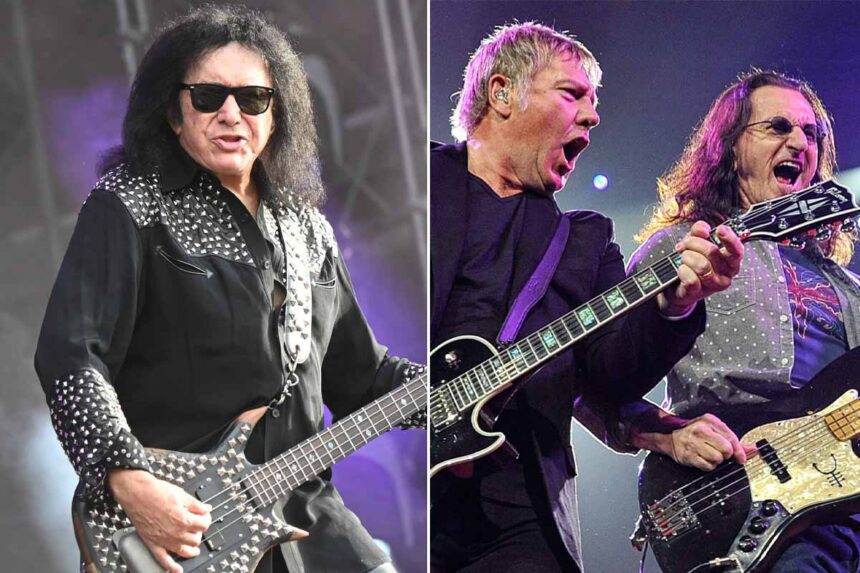
KISS bassist Gene Simmons recently opened up about how his band helped launch Rush’s touring career. Simmons revealed that Rush struggled to find tour support early on and credited KISS with giving the Canadian rock trio their first big break.

The conversation began when Simmons was asked directly about KISS’s history of touring with Rush.
“I saw Rush the other day and they were so good. And of course, you know, you guys famously toured together back in the day,” the interviewer asked.
“No, it’s a little it’s a little different. We took him from nowhere. Nobody would give him a tour cuz they were Canadian, right?” Simmons responded. “But when Paul and I heard Working Man and especially Yeah Yeah. I’m going, ‘What is that?’ And we didn’t care where it was from. For heaven’s sakes, I wasn’t born in America. So, we took Rush out on their very first tour and we’d had to torture the uh promoters who when you got there to do a show, I’ll never forget, we played Winterland in San Francisco and it was Kiss the Tubes and then Rush.”
Simmons went on to recall a specific incident from that tour involving Rush drummer Neil Peart, referred to in the story as “Getty.”
“And I remember Getty, I think it was Getty who came into our dressing room as we’re putting on makeup because we got to start two hours earlier while the opening bands are going on,” Simmons said. “And he’s going, ‘We’re really hungry. can you arrange food?’ I go, ‘What are you talking about? You should have food in your dressing room.’ He goes, ‘No.’ The prom so the promoter cheaped out. So half made up. I went over to Bill Graham and I said, ‘We don’t go on. You don’t feed our bands, we don’t go on.’ So they went out and got burgers and, you know, and stuff like that. Treat everybody the way you want to be treated.”
Simmons also reflected on a touching moment from one of Rush’s final shows, which paid tribute to KISS.
“It bears noting on the very last show in San Diego when Neil Peart was still, you know, alive, what they did was put was pay an homage to kiss,” Simmons said. “And right on stage were six-foot tall they were store what were they called? Like when you wanted to buy KISS stuff, it was like the band was there, you know, full height and we were on the stage for the entire evening. Look, you will meet the same people going up as you will going down. But so but so far so far so good.”
Simmons’s comments highlight the long-standing relationship between the two bands. That relationship traces back to the mid-1970s, when Rush was still fighting for recognition outside Canada. KISS gave Rush their first major touring opportunity despite initial resistance from promoters. That early support became a defining moment that shaped Rush’s career for decades to come.
Rush’s first show in the United States actually came on May 18, 1974, in Lansing, Michigan, where the band opened for KISS. Just a couple of months later, on July 25, 1974, Rush opened for KISS again at Centennial Hall in London, Ontario. That show also marked original drummer John Rutsey’s final performance with the band before Neil Peart joined later that year.
The two bands continued crossing paths on the road throughout 1974 and 1975. Rush regularly served as an opening act for KISS during a stretch that proved critical to building the band’s live reputation in the United States, making KISS’s willingness to bring them along on tour all the more significant.
Geddy Lee has since pointed to “Working Man” as the song that best defines Rush as a band. That sentiment echoes Simmons’s own memory of the track catching his and Paul Stanley’s attention in the first place. Lee once said the song is “the essence of what Rush really are as a band,” reinforcing just how pivotal that early material was in convincing KISS to take a chance on them.
Source: 101 WRIF


