




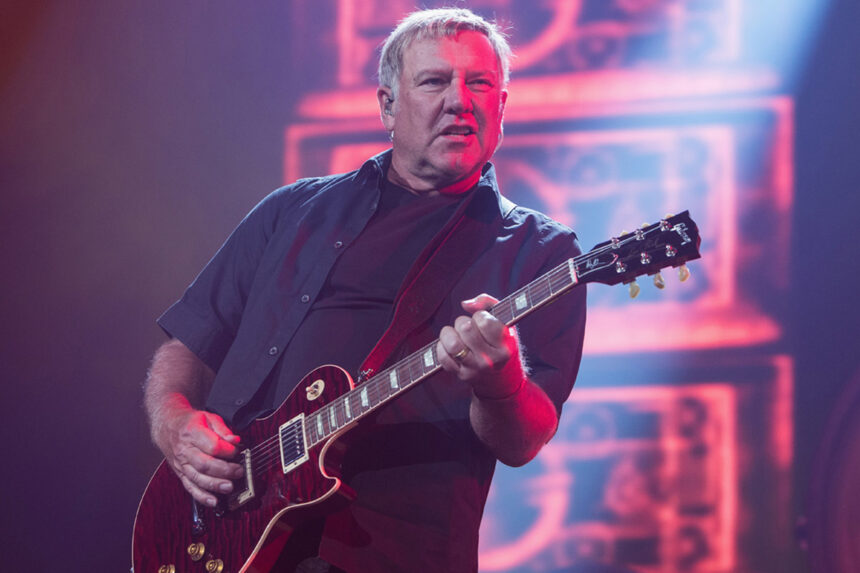
Alex Lifeson has opened up about his strong preference for recording alone. In an interview featured on Rick Beato‘s YouTube channel, he made clear that outside input during studio sessions is something he finds deeply counterproductive.

The Rush guitarist explained that when working on overdubs, he needs complete solitude to develop his ideas freely. He noted that well-meaning suggestions from others can derail his creative process entirely.
“Generally when I’m doing overdubs, there’s no one else in the room,” Lifeson said. “I always much preferred it when I was in the room by myself. I could concentrate. I appreciate that people have ideas and they’re only trying to help, but when you’re working on something, you want to develop it.”
Lifeson went on to describe how constant suggestions interrupt the fragile and time-sensitive nature of creative performance.
“Having somebody say, ‘Hey, why don’t you try? Why don’t you try? Why don’t you try?’ It’s the worst thing,” he continued. “Because it takes time to come up with stuff and then you only have a very short window of performance if you want to capture it, you know, in the best way possible.”
The comments offer a candid look into Lifeson’s creative philosophy and the conditions he believes are essential for producing his best work in the studio.
That philosophy, however, has never meant that Lifeson approached recording carelessly. Across Rush’s long career, his studio work was defined by deliberate craftsmanship and a deep attention to sound design. These were qualities that required the kind of focused, uninterrupted environment he has consistently sought.
As Jagged Time Lapse reported, tone and texture were central to Lifeson’s studio approach. Delay, chorus, phasing, and distortion formed the core of his effects palette throughout Rush’s recordings. He built guitar parts in careful layers, shaping each sound around the composition rather than simply filling space with lead playing.
That compositional mindset extended to how he thought about his role within the band. A 1984 Grace Under Pressure breakdown revealed that Lifeson’s sense of tone was primarily focused on the songwriting process itself — a reflection of his belief that guitar work should serve the song above all else.
Despite the intensity of his creative standards, Lifeson has also spoken warmly about the recording experience overall. In an interview with Make Weird Music, he reflected on a particularly smooth album session: “The recording process itself was really a lot of fun and for the most part quite smooth. That doesn’t happen really very often.” The remark suggests that while Lifeson guards his creative space fiercely, he is equally capable of embracing the joy of the process when the conditions are right.
Taken together, these details paint a picture of an artist who is neither precious nor rigid, but deeply intentional. For Lifeson, the ideal studio environment is not about isolation for its own sake. It is about protecting the fragile, spontaneous moments where the best performances are born.